
The Evolution of VUCA: What Today’s Leaders Must Practice Now

Photo Credit: Jakob Owens via Unsplash
For more than a decade, leaders have been asked to lead in a VUCA world, one defined by volatility, uncertainty, complexity, and ambiguity. What once felt like a temporary season has become the ongoing context of leadership.The pace of change has not slowed. It has accelerated. Leaders are navigating AI adoption, shifting market expectations, workforce fatigue, evolving cultural norms, and economic pressure … often all at once. And alongside the strategic complexity is the very real human impact of all of this on the people they lead.
As Margaret Heffernan likes to say, “For good or ill, uncertainty is not going away. It is the condition under which we work.”
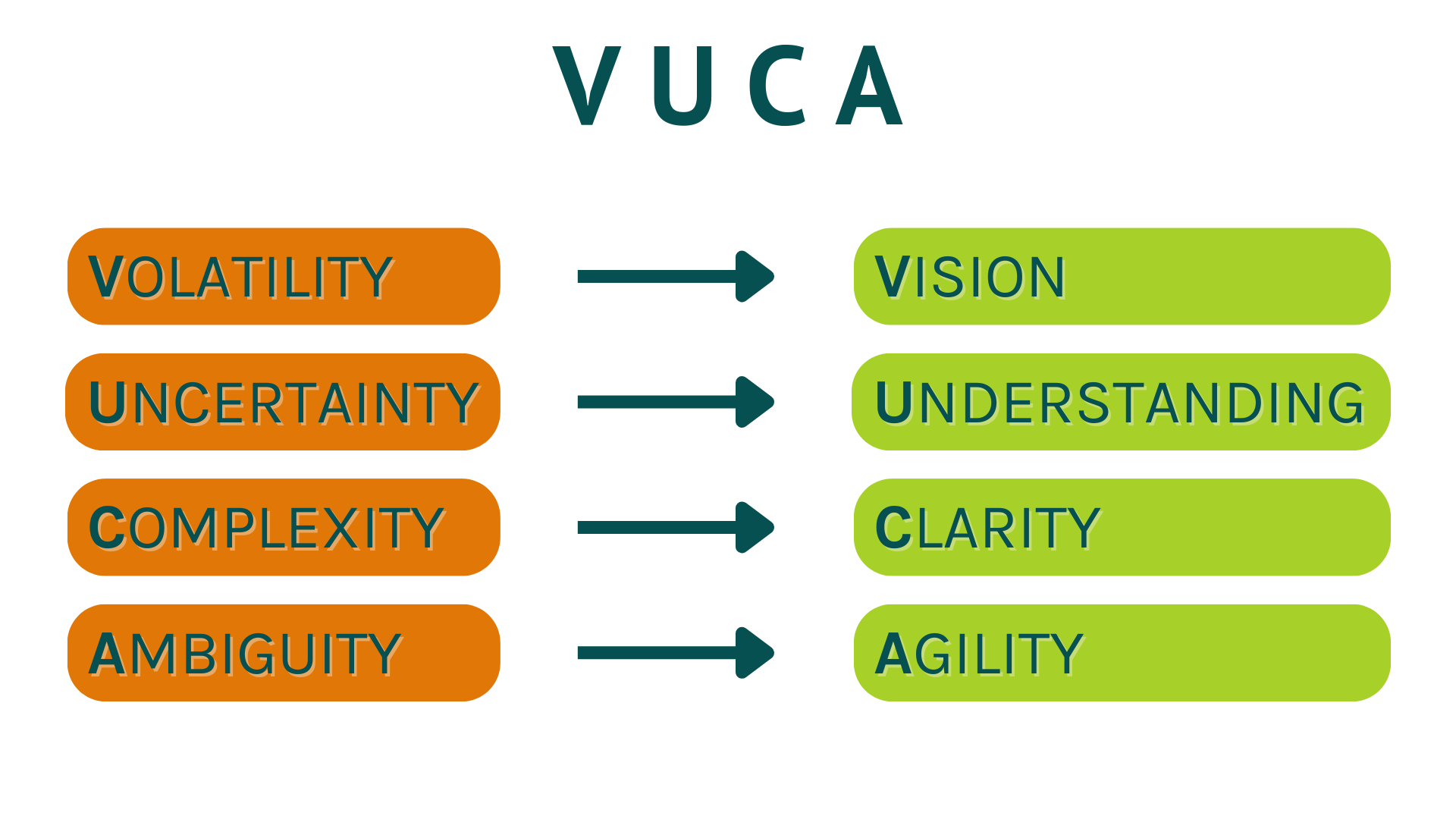
In response to this reality, Harvard Business School professor Bill George reframed VUCA in an interesting way a few years ago. Rather than positioning it as something to fear or manage away, he proposed an entirely different leadership response to the times we work in: Vision, Understanding, Clarity, and Agility. His interpretation invites leaders to stay oriented, grounded, and purposeful, even as the conditions continue to shift under their feet.
This reframing matters because it shifts the question. Instead of asking, “How do we eliminate volatility?” it asks, “How do we lead well inside it?”
The larger invitation is to prepare leaders and leadership teams to lead well in an uncertain world by developing the inner orientation these conditions require. Bill George’s reframing points leaders toward what matters most in times of disruption: clarity of purpose, grounding in values, and the ability to stay connected to one another as things change. Rather than promising certainty or control, this approach emphasizes steadiness and thoughtful action.
And steadiness shows up in how leaders run meetings, communicate decisions, respond to setbacks, and regulate themselves when the pressure is on.
Steadiness as a Leadership Practice
Vision, Understanding, Clarity, and Agility function as leadership disciplines that require consistent practice. Their effectiveness depends less on strategy and more on the internal capacity of the person leading.
In sustained uncertainty, teams are looking for orientation. They need leaders who can name what matters, provide direction when the full picture is still unfolding, and maintain enough stability that work can continue without unnecessary escalation.
Steadiness supports that kind of leadership. It appears in how a leader communicates change, how they respond when new information disrupts a plan, and how they regulate their tone and pace when pressure rises. It allows leaders to make decisions without transmitting anxiety and to adjust course while remaining connected to purpose.
Bill George’s reframing of VUCA endures because each element relies on this foundation. Vision requires sustained focus on purpose. Understanding requires attention. Clarity requires thoughtful judgment. Agility requires disciplined adjustment.
When steadiness is present, these practices strengthen trust and make forward movement possible.
Vision: Direction Without Prediction
In a VUCA world, vision is about direction more than simply forecasting outcomes. Steady leaders serve as a north star or a port in a storm, helping others stay oriented when the future can be imagined but not predicted.
They ask why. They name what remains non-negotiable: values, purpose, and intent, even as strategies and plans change. Vision answers an essential question: What are we holding as true, even as everything else shifts?
Practically, this might sound like:
“Here is what is changing.”
“Here is what is not changing.”
“Here is why this still matters.”
When leaders stay grounded in purpose, vision becomes a source of reassurance rather than pressure, connecting people to meaning and to the moment, rather than to outcomes.
Understanding: Curiosity Before Certainty
Understanding begins with listening. In uncertain environments, steady leaders resist the impulse to move too quickly to answers or into action. Instead, they choose to listen mightily, rather than make assumptions.
Understanding asks leaders to move to empathy before execution. They separate facts from interpretations. They check their bias. They are adaptive rather than fearful in the face of uncertainty.
In practice, this looks like slowing a conversation down long enough to ask:
• “What are we assuming here?”
• “What data are we missing?”
• “How is this landing for the team?”
In doing so, they reduce reactivity, both their own and that of others, and create space for shared sense-making.
Clarity: Making Sense Of Complexity
Clarity restores calm. In complex systems, confusion often destabilizes people more than bad news ever could. Steady leaders simplify where they can and pay attention to unnecessary escalation.
Clarity shows up in a leader’s ability to name priorities, roles, and next steps. It sounds like:
• “The top priority this week is…”
• “Decision ownership sits with…”
• “We do not yet know X, and we will update you by Friday.”
They use simple language, repeat key messages, and translate strategy into human terms.
Clarity, ultimately, helps people move inside complexity.
Agility: Adapting Without Panic
Agility is about flexibility and responsiveness. Steady leaders adjust without becoming over-reactive. In practice, they:
run small experiments to learn what works
are transparent about what is working and what is not
learn in public
normalize iteration
give themselves and others permission to recalibrate as new information emerges
Instead of announcing sweeping pivots, they test, gather feedback, and refine. Without steadiness, agility can quickly turn into chaos. With it, adaptation becomes thoughtful and sustainable.
From VUCA as Condition to VUCA as Practice
Reframing VUCA from volatility to vision, uncertainty to understanding, complexity to clarity, and ambiguity to agility is a powerful and useful shift. But sustaining that shift requires more than intention or technique. It requires inner capacity.
Steadiness shows up in self-awareness (including nervous-system awareness) and in the capacity to regulate one’s inner life, especially under pressure. It shows up in whole-system decision-making that takes the full picture into account, rather than leaping toward a single outcome. It shows up in shared ownership during change, in mindfulness and reflection, and in the thoughtful integration of human judgment with emerging technologies like AI.
Steady leadership shows up in how leaders respond when plans change, how openly they learn and how well they help others stay oriented when the way forward is still taking shape.
In a world where VUCA is no longer temporary, steadiness is not optional. It is the ground from which vision, understanding, clarity, and agility are lived, not just named.
A Practical Reset for Leaders
If steadiness is a practice, it can be practiced immediately. Consider choosing one of the following this week:
In your next meeting, clearly name what is changing and what is not.
Before responding to a tense moment, pause long enough to notice your own physical response. Slow your breathing, then speak.
Identify one area of complexity and reduce it to three concrete next steps your team can act on.
Run one small experiment instead of launching one large initiative.
Then reflect: When pressure rises, what tends to destabilize me first? What would steadiness look like in that moment?
Continue the Practice of Steady Leadership
Watch our recent First Friday webinar, Creating Steadiness in a Rapidly Changing Workplace, where we explore how VUCA has evolved and what leaders can practice now.
Watch the recording >
This blog is part of a larger exploration. In 2026, we are following six leadership themes that reflect the conditions leaders are navigating right now.
Read the full overview of the six leadership themes >
