
Vertical Leader Development: Build Capacity in a VUCA World

Photo Credit: Jakob Owens via Unsplash
What can leaders count on in the years ahead? More ambiguity, uncertainty and change. Like it or not.
The leadership challenge is to increase capacity in the face of it all, because traditional approaches to leadership development have not kept pace with the kinds of complexity leaders now face. Research has long suggested that only a small percentage of leaders possess the qualities of mind needed to lead effectively in volatile, uncertain, complex and ambiguous (VUCA) environments (Hall & Rowland, 2016). The good news is that many bright people have been working on this very agenda over the past decade and beyond.
What has been emerging from this work? Vertical leader development.
Why Traditional Leadership Development Is No Longer Enough
Before exploring vertical leader development and how to engage in it, it helps to begin with an area of study that has become increasingly familiar: neuroscience.
Julie Chesley, Hannah Jones, and Terri Egan, respected researchers in vertical leadership, note in their report Elevating Leadership Development Practices to Meet Emerging Needs, published in the Journal of Leadership Education, that there has been an “explosion of neuroscience research” over the past two decades. This research is shaping how leadership development is approached.
As David Rock explains, neuroleadership seeks to “improve leadership effectiveness within institutions and organizations by developing a science for leadership and leadership development that directly takes into account the physiology of the mind and the brain.” What we are learning about the brain, the mind, and the body continues to shape how leaders and organizations develop the people who lead them.
Leadership development is no longer only about what leaders do. It is also about who they are and how they think. Mindset matters. Carol Dweck’s work on the growth mindset has helped bring this understanding into the mainstream of organizational life.
Vertical development encompasses insights from both neuroleadership and mindset research and goes beyond them.
What Is Vertical Leader Development?
To understand vertical development, it is helpful to contrast it with a more familiar concept: horizontal development.
Horizontal development focuses on expanding a leader’s toolkit by adding new skills and competencies. Leaders gain knowledge, refine expertise and become more effective at what they already do. Examples include communication skills, conflict management and developing a more strategic approach to enterprise growth.
As Chesley, Jones, and Egan write, “The majority of leadership time and money is invested in the realm of traditional, or horizontal, development where the focus is on preparing leaders to successfully achieve stated objectives and building mastery in areas with relatively well-defined and agreed upon outcomes.”
Vertical development, by contrast, is about expanding mindset and changing how leaders think and make meaning.
Mindset refers to the mental models leaders use and their sense of identity. Vertical development focuses on transforming how leaders think, which in turn shapes what they do and how they behave. It emphasizes becoming more adaptable, more self-aware, and more collaborative, as well as better able to span boundaries and work across networks.
Vertical development also attends to the whole person. Chesley, Jones, and Egan describe this as development across the SPINE dimensions: Spiritual, Physical, Intellectual, Intuition and Emotion.
From Concept to Practice
To help distinguish between horizontal and vertical approaches, the authors developed a comparison that clarifies their differences.
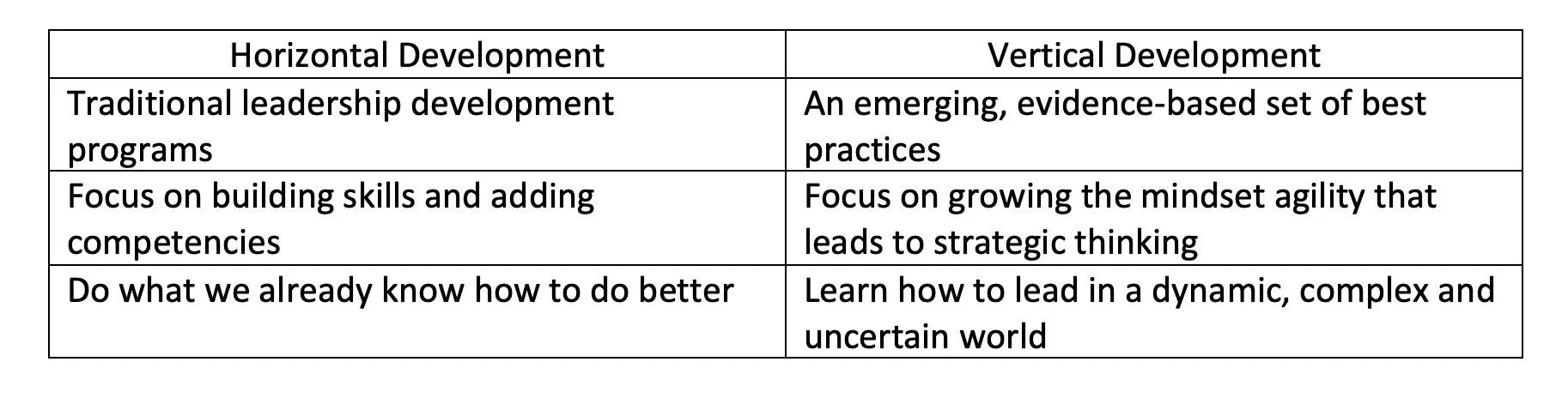
Horizontal vs. Vertical Development table, courtesy of Chesley, Jones and Egan, Journal of Leadership Education
In their article, the authors also offer practical actions organizations can take to integrate vertical development into assessments, individual development plans, knowledge sharing, mentorship, coaching and experiential learning. These examples take much of the mystery out of a big idea and provide a clear sense of where to begin.
Vertical Development as a Response to VUCA
VUCA is the operating environment.
Volatility tests emotional steadiness.
Uncertainty tests our tolerance for not knowing.
Complexity stretches our ability to see systems rather than fragments.
Ambiguity presses on our judgment.
These conditions ask leaders to expand how they think. Horizontal development builds skills for predictable terrain, while vertical development grows the internal capacity to lead when the terrain keeps shifting.
Research in adult development shows that as leaders mature in how they make meaning, they become more capable of holding paradox, integrating multiple perspectives and collaborating across differences. In other words, they become better equipped for VUCA conditions.
So now, executive coaching, experiential learning, and reflective practice are essential pathways for expanding one’s capacity.
The Invitation
The larger invitation is to prepare leaders and leadership teams to lead well in an uncertain world, a VUCA world, by engaging in vertical leader development. This work offers not only a practical response to complexity but also a meaningful, growth-filled journey.
New challenges call for new ways of learning and leading.
What might become possible if we truly commit to growing leaders from the inside out?
Five Practices to Build Vertical Capacity in a VUCA World
Vertical development is not a theory to admire. It is a practice to inhabit.
Here are five ways to begin:
1. Interrupt your first conclusion.
When tension rises, notice the story you are telling. Ask: What might I be missing? What else could be true here?
2. Invite a wider lens.
Seek out perspectives that stretch your own. Complexity rarely yields to a single viewpoint. Where could you ask for more feedback, seek a different perspective, or invite shared sense-making?
3. Examine your meaning-making.
After a challenging moment, reflect not just on what happened, but how you interpreted it.
4. Build deliberate reflection into your week.
Fifteen quiet minutes. A walking reflection. A coaching conversation. Capacity grows through integration.
5. Stay at the edge of your current thinking.
Growth happens where certainty softens and curiosity strengthens. What might be addressed with new skills or tools, and what might require a different way of thinking or being?
These practices may feel small. Over time, they change how leaders show up.
Continue the Conversation
Vertical development is one thread in our larger 2026 focus on cultivating steadiness in a changing workplace. If you missed the introduction to this theme, start there.
You can also watch the recording of our recent webinar, Creating Steadiness in a Rapidly Changing Workplace, for practical insight into how leaders can grow capacity in today’s VUCA environment.
