
Why Leaders Grow Faster in Community and What to Do About It
Leadership development | Peer learning | Cohort programs | Executive coaching | Seattle
There is a particular kind of exhaustion that comes with leading well. The weight of carrying complexity without a thinking partner. Making hard calls in the quiet. Sitting with uncertainty and having nowhere to put it.
Most leadership development has been designed for individuals. One assessment, coach, or workshop. The model assumes that if you sharpen enough people one at a time, the organization gets sharper. The research is starting to say otherwise.
What the Research Actually Shows
A 2024 study published in the Journal of Healthcare Leadership followed rehabilitation professionals through the first year after leadership development training and found that shared experiences in a peer leadership network influenced growth across all leadership levels, regardless of where someone started in terms of seniority or networking skill. The study, conducted by Emily S. Becker at Northwestern University, identified three consistent outcomes: a deepened opportunity to connect, the formation of a genuine community of leaders, and a peer network healthy enough to sustain collective leadership over time. (Read the full study)
What makes this finding worth attention is its setting.
Healthcare leaders operate under sustained pressure in environments where complexity is constant, and peer support is rarely built into the work structure. If community-based development moves the needle there, the implications extend well beyond healthcare, into utilities, technology, and mission-driven organizations navigating comparable strain.
The same study found that participation in a peer leadership network contributed to increased job satisfaction, stronger connectivity across the organization, and expanded collaboration. These are outcomes HR leaders and organizational decision-makers recognize immediately, because they show up in how teams function day to day.
The Isolation Problem Is a Design Problem
Leadership isolation tends to be treated as a personal challenge, something a resilient enough leader should be able to manage. A more useful frame is that it is a design problem, one embedded in how roles get structured and how development programs get built.
Harvard Business School professor Amy Edmondson spent decades researching what actually enables teams to learn. Her original finding (that teams who reported more errors also performed better, because open communication allowed them to identify and correct mistakes) led to a body of work on psychological safety that has become foundational to how we understand organizational learning. Her 2018 book The Fearless Organization translates that research into practical terms: when people are afraid to speak up, organizations lose access to the information they most need. (Edmondson's work at HBS)
What Edmondson's work illuminates is that the safety to think out loud, to say "I don't know," or "I got that wrong,” is the mechanism through which learning actually happens. And that kind of safety requires others to build and sustain. It cannot be self-generated.
This is where isolation becomes a structural liability. A leader who has nowhere to put uncertainty does not stop having uncertainty. They just stop naming it. And an organization full of leaders quietly managing complexity alone is an organization that has quietly stopped learning.
Community Is the Pedagogy
adrienne maree brown, in Emergent Strategy, offers a frame that lands differently than most leadership writing. One of her core principles: "There is a conversation in the room that only these people at this moment can have. Find it." The learning that emerges from a room of leaders who are genuinely present with one another, who bring their real questions rather than their polished answers, cannot be replicated in a course or a self-assessment.
Brown's framework challenges the assumption that change happens through individual effort scaled up. Transformation is inherently relational, she argues, built through connection, sustained through relationship. Her work invites a move away from top-down leadership models toward more decentralized, collective approaches. For leaders in organizations navigating rapid change, that shift carries practical weight.
Peter Block gets at something similar in Community: The Structure of Belonging. His work on how communities form and restore themselves centers on the quality of conversations people are willing to have with one another. Block argues that gathering and engaged conversation are the primary mechanisms through which belonging is built. Among the six conversations he traces - invitation, possibility, ownership, dissent, commitment, and gifts - the conversation about gifts stands out for leaders specifically: the question of what each person brings to the room that only they can bring.
In a cohort or peer learning setting, that question becomes generative. People stop performing competence and start contributing perspective. That shift changes everything.
The Seniority Trap
Senior leaders are often assumed to have outgrown the need for peer learning. In practice, executives and directors frequently have the fewest opportunities for genuine peer reflection. They are expected to have the answers. The unspoken social contract of seniority can make authentic learning environments harder to access the further up someone goes.
The Becker study is instructive here, too: it found that all stages of leadership benefited from shared learning, with the peer network strengthening collective leadership across the organization rather than just at entry or mid levels. The assumption that senior leaders need less community may be one of the more costly beliefs organizations hold quietly.
What This Looks Like in Practice
At Henley Leadership Group, we have spent 20+ years watching what happens when leaders stop learning in isolation. The shift is visible - in the quality of thinking people bring back to their teams, how they hold difficult conversations, and even the steadiness that comes from knowing they are not working through hard things alone.
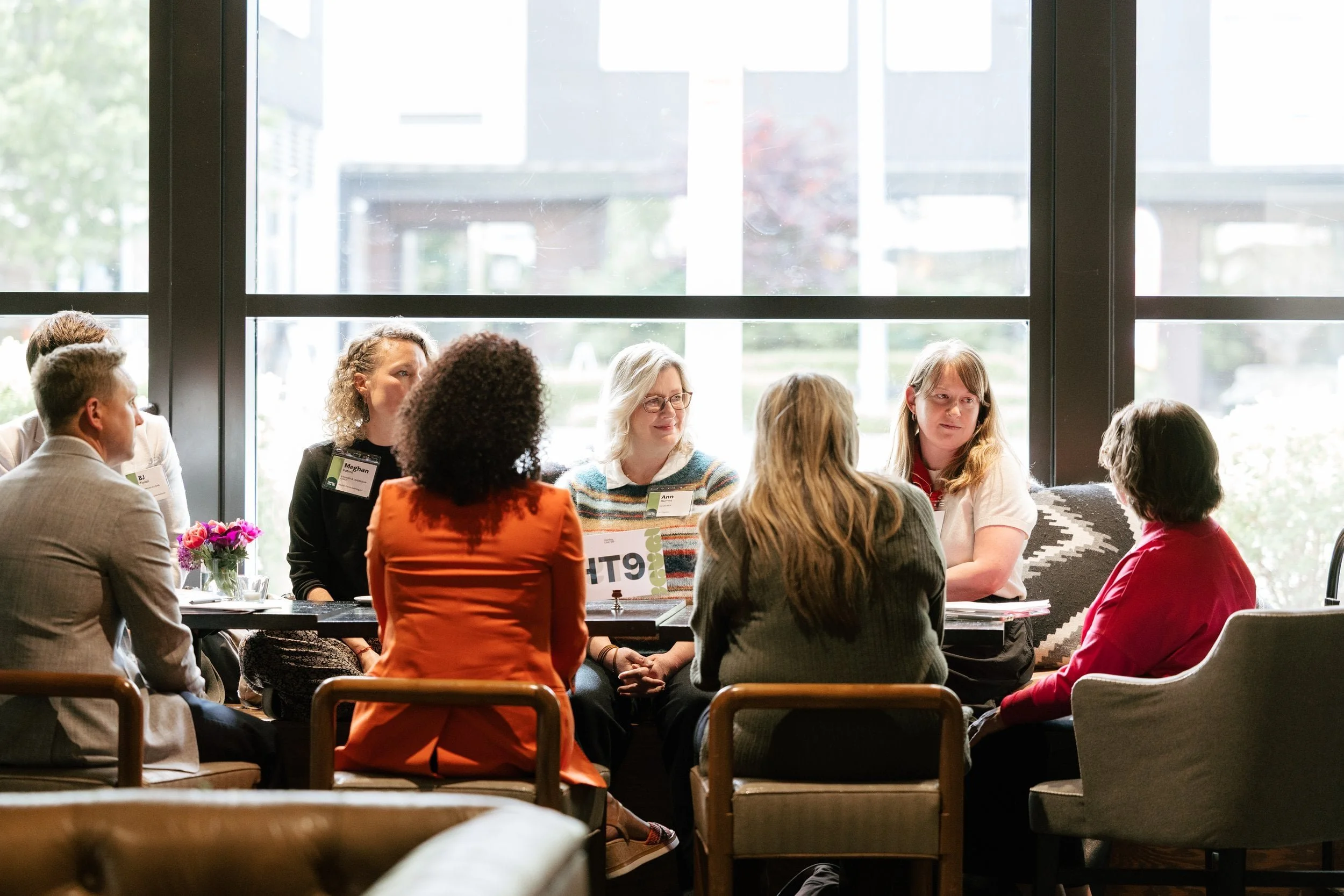
Our nine-month Inside-Out cohort program is built around this premise: that leadership development that lasts is development that happens in relationship. Participants bring their real challenges, such as the team dynamics that aren’t working, the strategic decisions that feel genuinely uncertain, and they think through them alongside peers who are navigating comparable terrain.
What leaders consistently tell us is that the cohort itself becomes a resource they didn’t know they were missing. Having a community that holds the work with them makes the learning actionable in a way that solo development rarely achieves.
A Practice: The Gifts Conversation
One of the most underused structures in peer learning comes directly from Peter Block's framework: the conversation about gifts. It is an antidote to the kind of meeting where everyone reports on problems and no one names what they are actually bringing.
For individual leaders: Set aside 15 minutes and write out answers to two questions. First: What do I bring to the rooms I am in that others genuinely rely on — even when I undervalue it myself? Second: Where in my leadership am I withholding that gift because the conditions do not feel safe or worth it?
The second question is the harder one. It often surfaces something true about where the real work is — building the conditions where what you already carry can actually land, rather than acquiring something new.
For teams or peer groups: Open a meeting by asking each person to name one gift they see in someone else in the room — something the other person might not see clearly in themselves. Keep it specific. Keep it honest. The point is a community that begins to see its people as contributors rather than role-holders, and that over time becomes a place where that seeing is mutual.
Block writes that transformation occurs when we produce deeper relatedness across boundaries and create new conversations that focus on the gifts and capacities of others. The conversation you design at the beginning of a gathering sets the terms for what becomes possible.
The Case for Building It Into Your Organization
If you are an HR leader or an organizational decision-maker, the ask is worth sitting with: what would it mean to treat community as infrastructure for leadership development, rather than a nice-to-have?
The organizational conditions that make peer learning possible, like protected time and genuine investment in relational learning, are within reach for most organizations that decide to prioritize them.
What tends to stop it is a lingering belief that leadership is fundamentally individual, that the work of growing a leader happens inside the leader alone, and that the community around them is an optional context. The research points elsewhere. So does the lived experience of every leader who has found their way into a room where they could finally think out loud.
Bring This Work to Your Team
If your organization is ready to build a culture where leaders grow in community, we would love to talk.
Henley Leadership Group works with organizations across healthcare, energy, tech, and the nonprofit sector to design leadership experiences that are relational and built to last. Our nine-month cohort program creates the kind of peer learning environment described here, with 1:1 leadership coaching woven throughout.
Connect with us to explore what community-based leadership development could look like for your organization.
Henley Leadership Group is an executive coaching and leadership development firm based in Seattle, Washington, serving leaders across the Pacific Northwest and beyond.