
Moon Joy: What Artemis II Taught Us About Leadership
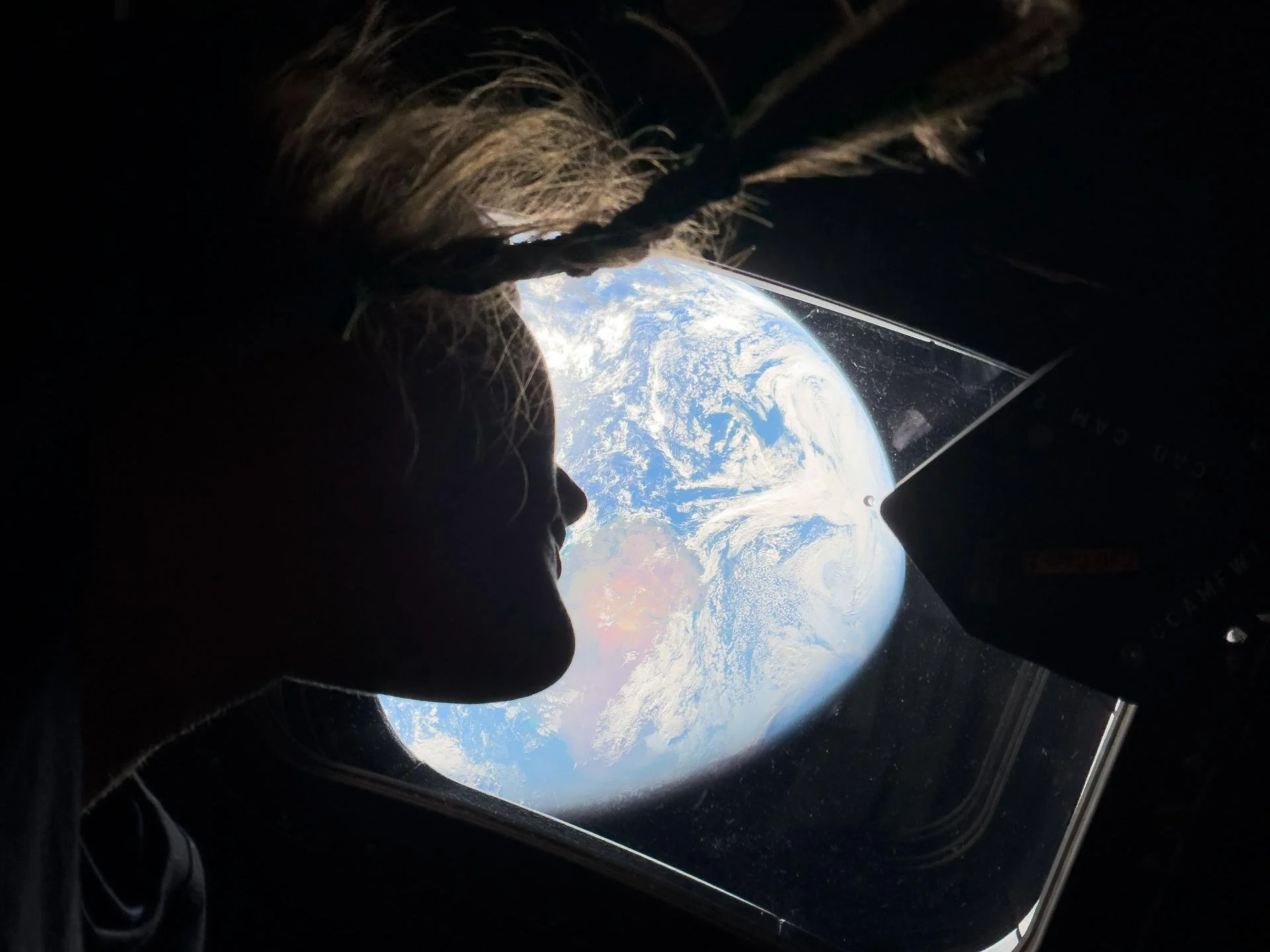
Photo credit: NASA
What a Trip to the Moon Revealed About Awe, Humility, Courage and the Kind of Leadership That Moves Us

Author: Courtney Caldwell
I, like so many others, have been infected with moon joy. I recently spent 270 hours live-streaming the Artemis II mission. I’m exaggerating, but maybe not by much. I also found a community among my fellow obsessed as I scrolled social media. I’m still basking in the euphoria we felt as we watched genius partner with humility, science mingle with wonder and bold heroism intertwine with the giddiness of discovery.
Absolute Awe
I can’t look away from them, and really their awe. Victor Glover, the first Black person to travel to the moon, searching for the words to describe the sun as it slowly reveals itself from the moon eclipse, described it as “baby hair.” Canadian mission specialist Jeremy Hansen brought Indigenous teachings about the moon into the mission. Christina Koch, the first woman to travel to the moon, said, “We will always choose Earth. We will always choose each other.”
As a human, I’ve become an Artemis II evangelist for the awe and the joy. And as someone who works in leadership development, I’ve become a student of what feels like one of the most impactful displays of leadership I’ve seen in a long time.
Why They Feel Like Leaders
Canadian mission specialist Jeremy Hansen shared his mission patch with the Seven Grandfather Teachings, core Anishinaabe (Ojibwe) principles of Love, Respect, Bravery, Truth, Honesty, Humility and Wisdom that he tries to live by every day.
These people have spent their lives putting everything into practice with the idea that maybe it would come to fruition, that maybe NASA would be able to convince Congress and the executive branch and taxpayers that humans can provide more than a satellite can. Maybe they’d get to use all that they learned. Maybe the awe of space, the desire to learn because of their curiosity and the maybe someday would carry them here.
And it became immediately clear to me why these poet-scientists are such awe-inspiring leaders.
Bravery
To shoot yourself into the universe, farther than any human before you, is certainly brave. And leaders often go first. Not in speaking or controlling the room or the outcome, but in trying the scary thing. All of them were brave in their physical and emotional vulnerability. They were learning and feeling and risking in public every moment of those 10 days, and that’s what seemed to capture our collective attention most. Perhaps with that amount of vulnerability, there is no other option but to show up as one’s full self.
I was particularly moved by Victor and Christina, who, because of their identities had more eyes on them and more risk in showing up as their full selves. It’s not safe for everyone to show up fully at work. Nor maybe should that be the expectation, but to see the possibility of it was powerful. And sometimes leaders go last, like when Commander Wiseman was the last to depart the ship when it landed off the coast of California, ensuring his crew was all safe first.
Truth
I used to be a high school teacher, and one of my favorite books to teach was Tim O’Brien’s The Things They Carried. It elicited great conversations about truth. Over the years, students and I helped each other navigate the difference between happening truth, the facts of events, and feeling truth, using any recourse to invite people to hear and feel our truth. Sometimes regular old words don’t do our truth justice.
Read the resumes of the four astronauts on this mission, and you’ll wonder what you’ve been doing all your life. The degrees, research, practice, remote locations and physical endurance are all impressive. But most of us non-astrophysicists weren’t hanging on every word for the science. Instead, we were hooked by the poetic language, the photographs and the sheer joy. And for Christina’s zero-gravity curls. They sent humans to the moon rather than another satellite because the mission wasn’t just about them sharing the science of what they were seeing. They needed to make us feel the miracle of their mission. Of seeing an Earth rise, of floating in a tiny box behind the moon, of taking a picture of almost 8 billion of us in one shot. They needed to get us to believe in NASA, continued space exploration and more money for these programs when there is so much need in our country and world.
Along with the poetry of the mission, they provided clarity about their purpose and their challenges. They were clear in their questions and answers. They celebrated when Koch fixed the toilet, on the fritz after only one day, and they tangled with Houston about trying to find an Excel document when they were packing up for re-entry. They spoke facts. They spoke wonder. And we felt the truth of the value of their work. We all need to understand why and how we’re doing the work we’re doing.
Honesty
This mission is groundbreaking not only for the science, but for the people who were on the journey. And there has been honesty about that. Pilot Victor Glover is the first Black person to travel to the moon. Mission Specialist Christina Koch is the first woman to do so. Mission Specialist Jeremy Hansen is the first Canadian.
The last time humans went to the moon, women weren’t even allowed to have their own credit cards. Now women are flying to the moon and leading Mission Control. After a floating jar of Nutella was spotted during the live-stream, Hansen had to prove to Prime Minister Mark Carney that he also brought maple syrup on the mission.
Different perspectives give us different poetry.
Humility
I suppose it’s not a coincidence that the astronauts who’ve traveled farther than any human don’t talk like they know everything. They talked like students and explorers. Their wonder and curiosity were on full display. The sheer vastness of experience seemed to dissolve their egos. Their competence was a balm. They were careful with words, and more excited by the new questions they were discovering than the answers they were sharing.
And they shared credit during the mission, especially since their return, with the thousands of people who made the mission possible, past and present. Koch credited their new distance record to Neil Armstrong, Katherine Johnson, Dorothy Vaughan, civil rights leaders and everyone who worked on building the spacecraft.
This humility extended to NASA’s team working on the ground, explaining to laypeople what was happening in terminology we could grasp. They treated us as fellow explorers, and we were caught up in their expansive welcome into their world. This modeling was contagious. Social media was full of “I don’t know if this is a dumb question, but…” posts. And thousands of respondents would contribute answers, celebrate the question, and say, “Not dumb at all!”
Leaders are curious. Leaders learn in public. They set the tone that we don’t have all the answers, we all make mistakes, and as the crew told schoolchildren on a call toward the end of the mission, “It’s not perfect, but we’re getting it done.” That seems like a plenty high standard.
Wisdom
There is no doubt as to the intellectual genius of these people. But wisdom is beyond what we know or can study. Wise people see beyond. During the mission, NASA stated that “human eyes and trained judgment” are the most important tools we have.
Once the crew was headed back to Earth, Koch noted, “We will always choose Earth, we will always choose each other.” Jenni Gibbons, responding from Mission Control, responded, “Integrity, from Earth, our single system, fragile and interconnected, we copy.”
Leaders are wise. While we may not be able to have a moon’s eye view, we can have a bird’s eye view of the work and our teams. We see how it’s all interconnected, how we rely on one another in a fragile and complicated system. And we work to help our teams make sense of it and nurture it.
Respect
During my 10-day obsession, I kept thinking of a recent clip I saw of author and sociologist Tressie McMillan Cottom talking about the need to push back on systems and people who are trying to convince us that the future is already written. It’s not. WE will write it. And we should be intentional about writing the future we want to create. Koch noted, “Everything we need, the Earth provides.”
Leaders respect the resources they have, the gifts their team members provide and the possibility of what’s not yet written.
Love
By now, if you haven’t seen the clip of Hansen requesting a crater discovered by the Integrity crew be named after his friend, Commander Wiseman’s late wife Carroll, then stop reading this and go watch immediately. Hansen’s voice breaking when he described “a bright side on the moon,” found in the liminal space between the near and far sides of the moon. Commander Wiseman’s zero-gravity launch into his friend and colleague’s arms. Then, the group hug. It was love. This leader was so loved by his team that during their pre-launch quarantine, the team proposed the idea.
Days later, as the crew was packing up in preparation for their re-entry, they kept finding small notes and treats hidden by the ground crew, pebbles of love and “thinking of you” from 250,000 miles away.
After Reid, Glover, Koch, and Hansen landed, NASA Associate Administrator Amit Kshatriya spoke about the love people were experiencing watching this mission and said, “If you can’t take love to the stars, then what are we doing? Why would we even go?”
If we can’t love our work and the people we’re doing it with, note, I didn’t say like all the time or find it joyous at all times, I said love, something deeper than that. Then what are we even doing? Why would we even go?
Not all leaders are going to hug their colleagues multiple times a day or cry in celebration or grief or tell everyone they love them every day. Nor should they! But these stories aren’t just heartwarming. We know that belonging, a business-appropriate word for when we really mean love, is good for business. There’s plenty of data on that. But when we watched these four people in space and the hundreds of people supporting them on Earth, we didn’t need the data to see the impact leaders who love what they’re doing and the people they’re working with can achieve.
Back to Work
Monday morning, about 60 hours after the Integrity crew returned to Earth, Christina Koch was back at work testing a new space suit being developed for future Artemis missions, testing mobility and working on tasks that the next group to land on the moon will have to execute. There was something comforting about seeing her back at work. Because leaders know the work is never done. Even if you travel 600,000 miles, it’s back to work on Monday.
Are you ready to lead with the uniquely human qualities that make a difference?
Discover how our leadership development programs can empower you or your team to grow with fresh insights, practical tools, and bold strategies designed to amplify your most authentic strengths. To deepen your impact, explore our specialized offerings in executive development, emerging leader development, and team collaboration, all crafted to help leaders thrive in today’s dynamic environment.
Stay connected and inspired by subscribing to our newsletter for ongoing leadership insights and resources that support leading with heart and purpose.